
The Madison Conservation District is excited to announce an opening for a District Administrator to…
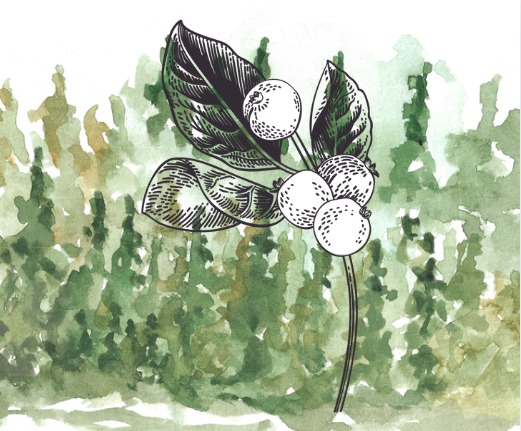
Meet the Common Snowberry
There is not much snow blanketing the valley as we roll into the New Year, so instead I’d like to draw attention to the little white berries whose common name was likely inspired by their likeness to a snowball. The Common Snowberry or Symphoricarpos albus is native to Montana and can be found throughout most of state. You may have noticed its waxy, snow-white berries, adorning thin branches along the trails in fall and into winter. A member of the honey family (Caprifoliaceae), the snowberry is a hardy shrub that usually grows 3-9 feet tall, and can be found in a variety of areas, including shady forests, riparian zones, or rocky slopes. Its smooth, oval-shaped leaves occur opposite one another on its twig-like branches. Before donning their iconic white berries, the plant produces small pink flowers often clustered together in the summer months. The flowers are important for pollinators and are known to attract song birds, hummingbirds, butterflies and bees.
Snowberry plants rarely reproduce through seeds. Instead, they spread through sprouting underground stems called rhizomes, allowing the plant to form dense patches or thickets. These thickets provide essential habitat for birds and small mammals. The berry itself contains a compound called Saponin. This natural, soap-like substance can taste bitter and may be toxic in large amounts to humans and some animals, such as fish. For browsing animals, such as deer and elk, the leaves provide a much-needed winter food source when other food is scarce, while birds and sometimes bears snack on the berries. The stems can also serve as food for mice and rabbits, making the snowberry plant a surprisingly high-demand forest commodity.
Despite the toxicity that the raw berries risk for humans, the plant has a long history of ethnobotanical uses. Saponins have both antioxidant and antimicrobial properties, and when crushed and combined with water, create a frothy lather that can be used to wash your hands or cleanse your hair. The berries have also been crushed and rubbed on skin to soothe and heal rashes, burns, and warts. Teas made from soaked roots were used to ease stomach aches, and the twigs soaked to make tea to treat fevers.
As winter settles in, snowy or not, the snowberry stands out as a quiet constant on the landscape. Its bright white berries add contrast to the muted colors of fallen leaves and bare branches while providing food and shelter for wildlife when resources are limited. Next time you’re out exploring our valley in the latter months of the year, take a moment to notice and appreciate the resilient snowberry, and maybe wash your hands while you’re at it, too!

Related Posts



Comments (0)